



This is Your Community Story of the Week:
This week, I had the honor of flying down to Saltillo, Mexico, with my good friend Christopher Delgado to witness something spectacular. Chris donated a brand-new, turf soccer field to a community where kids have been playing on dirt fields their entire lives.
In Saltillo, Mexico, poverty runs deep, but gratitude runs deeper. As we drove through the streets, I watched families living with almost nothing. Meeting them, it was clear that they don’t complain about what they don’t have. They celebrate what they do.
When we arrived for the ribbon-cutting ceremony, the energy was electric. Families filled the stands. Kids pressed against the fence, waiting to step onto real turf for the first time. The gratitude in their eyes, the hugs, the smiles, it wasn’t just about a soccer field. It was about someone seeing them, someone caring enough to invest in their community.
At dinner that night, one of the community leaders asked us, “What was your favorite part of this week?” Everyone shared beautiful reflections about the ceremony, the people, the impact. For me, the answer was simple: playing soccer with the kids.
After the ribbon was cut, I stepped onto that field and kicked the ball around with them. I shot on their goal. They shot on mine. We dribbled, we laughed, we competed. Those kids saw me as someone willing to play the beautiful game, and that’s what I’ll remember most, the connection.
I showed my boys pictures of the trip when I got home. They’ve never had to play on dirt fields. They’ve always had perfectly cut grass, brand new balls, clean uniforms. They don’t know what it’s like to be grateful for turf. But I want them to see what I saw: gratitude.
Chris Delgado inspired me and so many others in our circle to live with a philanthropic mindset. Because of this trip, I’ve decided to donate uniforms, equipment, jerseys, and soccer balls to that team in Saltillo It’s not about the money. It’s about showing up for a community that needs it and teaching my boys what legacy really looks like.
Next, this is your insider’s look at the latest in parenting and leadership!
Headlines:
Are You a Tiger Parent Without Realizing It? What the Research Really Says
“Tiger parenting” is often misunderstood as harsh, but experts say it usually comes from protection — parents wanting their kids to be disciplined, resilient, and ready for a competitive world. If you don’t know the term, this parenting style pairs strict rules and high expectations with varying degrees of emotional warmth.
Done well, it can build grit, responsibility, and strong work habits. Pushed too far, it can create anxiety, perfectionism, and a sense that children are valued only for achievement. Researchers also warn that the term can stereotype families, even though most don’t use this approach. The real issue is how fear, culture, and personal history shape what parents believe is “good parenting,” and how easily high standards can become pressure.
This is a tough one because it’s all based on culture. In my household, my wife comes from a German culture that leans more toward that strict, high-expectation style. I’m a lot more relaxed, especially after everything I’ve discovered about the education system over the last four or five years. Honestly, I don’t trust it the way I used to. But here’s the thing: high expectations aren’t just about grades. They apply to anything — athletics, arts, music, character. If you want to be great at something, it requires discipline and focus. That’s true whether you’re raising a scholar, a musician, or an athlete.
As a soccer coach, I see this play out every week. On the field, I’m high energy, high intensity. I expect a lot from my players because we’re there to train and become better. But that intensity can create an imbalance when I’m also their father. At home, I’m more relaxed. I don’t yell. I have conversations. I say, “This needs to be done,” and my boys know I mean it. They respect that.
Every kid is different. Some are easily coached. Some need more attention. Some need tough love, and some need patience. The key is evaluating what works for your child and finding balance. Tiger parenting might work in some areas and not in others. The goal is growth. And that looks different in every home.
Next, this is your Alpha Parent of the Week:
Veteran on the Brink Finds New Life Through His Service Dog
When Navy veteran Mario Graham-Tutt hit a breaking point after years of depression and PTSD after nine deployments, he quietly prepared to end his life. Everything changed when he found a business card from Northwest Battle Buddies, a nonprofit that pairs veterans with fully trained service dogs. Mario was matched with Kayden, a black lab trained to interrupt panic attacks, provide grounding in high-stress environments, and help restore a sense of safety. That partnership saved his life.
The organization, founded in 2012, just celebrated its 300th veteran–service dog pairing. Each dog undergoes five months of specialized training before meeting its veteran, who then completes a five-week course to learn how to reinforce the dog’s lifesaving behaviors. These dogs can detect panic attacks, seizures, and shifts in blood pressure, providing emotional support for veterans fighting invisible battles. Mario now volunteers for the program, committed to helping others the way Kayden helped him.
As a veteran and a dog owner, this story hits close to home. As fathers, we try to carry everything on our shoulders. We try to figure it out alone. We think asking for help makes us weak.
But strength isn’t found in isolation. It’s found in connection.
This story reminds me that having a support system — whether it’s an animal, a close friend, a mentor, a podcast, or a spouse — can make all the difference. We don’t have to go through life alone. There are resources out there. There are people willing to share their experiences and help you through what you’re facing.
Recently, someone I don’t know very well reached out and asked me for help. He wanted to be a better father and a better husband. I don’t know why he chose me — we’ve only talked on the phone a few times — but I think that hard conversation, the one where he admitted he was struggling, was the breakthrough he needed.
Admitting you need help isn’t weakness. It’s courage. Once you admit it and reach out, you find a way forward. If you’re struggling, don’t wait. Reach out to someone you trust. And if you need a resource, you can always email us at admin@raisingalphasproject.com. We’d love to help.
The Courage to be Vulnerable
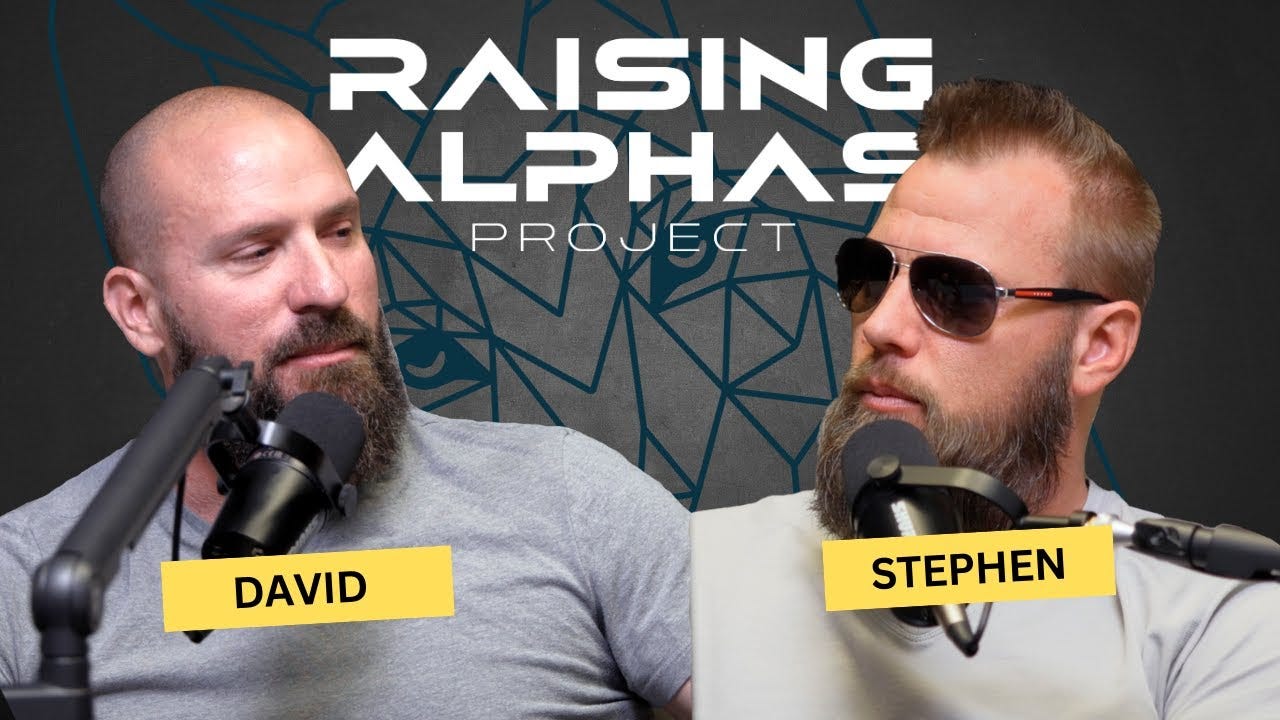
In this powerful episode of the Raising Alphas Project, David Panzik and I dive into the importance of being vulnerable as a man — in family, business, and fatherhood. Too often, fathers believe they have to carry everything alone, that admitting struggle is weakness. But as we explored in this week’s Alpha story about veterans and service dogs, real strength comes from connection, not isolation. This episode challenges the myth that vulnerability makes you less of a leader and shows how opening up actually makes you a better father, husband, and mentor.
You can watch the full episode at the link above.
Alpha Challenge of the Week
This week, I challenge you to get involved in your community. Find a way to give back, whether that’s volunteering at a local organization, donating to a cause that matters, or simply showing up for someone who needs it.
It doesn’t have to be a trip to Mexico or a brand-new soccer field. It can be as simple as coaching a team, mentoring a young person, or helping a neighbor. Community involvement teaches our kids that life isn’t just about what we achieve for ourselves —it’s about what we give to others.
Show your kids what it looks like to serve. Show them what gratitude looks like. And show them that legacy is built not by what we accumulate, but by how we lift others up.
Ask an Alpha --- We’ll Answer your Question on the Show
Do you have a parenting or leadership question you want some real talk on? Email us at admin@raisingalphasproject.com and put “Ask an Alpha” in the subject line.
Share:
-
Your parenting challenge in one or two sentences
-
What you have tried
-
What you hope to achieve
We may read your question on air and give you a clear next move!
Thank you,
~ Chief Stephen Davis